
GSCA Wrap: AI, 3D, Camera Test Results, and Awards
The Giant Screen Cinema Association International Convention wrapped Thursday in Universal City.


By Carolyn Giardina
The Giant Screen Cinema Association —a close-knit community that supports the giant screen business from planetariums to Imax—discussed artistry, tech and business during a four-day conference in Universal City, Calif., with a focus on the future of its industry.
The event concluded Thursday with an awards ceremony celebrating films including MacGillivray Freeman Films’ Call of the Dolphins, SK Films’ Horse Power, SK Films’ Secrets of Great Salt Lake and Cosmic Picture’s Wild Rescue alongside James Cameron’s Avatar: Fire and Ash. The GSCA Awards recognized Cosmic Picture’s 2013 film Jerusalem with the Imax Hall of Fame Award. Additionally, a special recognition was awarded to MacGillivray Freeman for its pioneering aviation doc To Fly!, which premiered in 1976 for the grand opening of the Smithsonian Institution’s National Air & Space Museum and a half-century later, continues to play in the venue. The film has been included in the National Film Registry and its estimated that more than 100 million viewers have seen To Fly! in screenings throughout the world.
“We’re extraordinarily privileged. We’re extraordinarily lucky. We’re in the inspiration business,” said 40-year industry vet Mike Lutz of Lutz Strategies, who recognized his mentors, colleagues and family as he accepted the GSCA Outstanding Achievement Award. Restating that GSCA members are in the “inspiration business,” a term he attributed to California Science Center CEO Jeffrey Rudolph, he also admitted “business could be better.”
Noting that for him, GSCA is a reminder of the talent in the community, he added, “I’m not just saying that we can make another To Fly moment. I don’t know. What I’m saying is, let’s please try to reflect for a moment and ask ourselves how we all can be cogs in a system that creates that flashpoint again. We need another To Fly moment.”
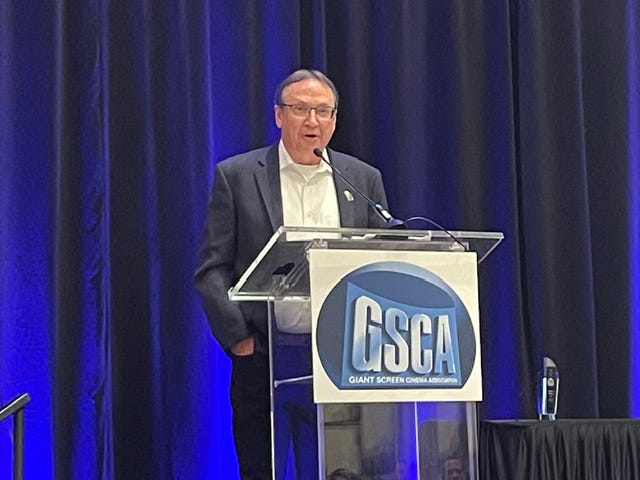
During the conference, screenings were held at Universal Cinema AMC at Citywalk’s Imax auditorium, while sessions were held the Imax theater and at the Universal Hilton, included discussion of AI’s impact on the giant screen business.
On the future of the business, Cosmic Picture president Joanie Vandenberg Philipp reported that fewer kids are going to museums and other such venues, while adults 55+ is a growing market with discretionary money, time and “curiosity.” She suggested the GSCA’s opportunity is to make films for adults while also still servicing families.
“You are the gold standard. … Maximize you assets,” she said, also encouraging the community to take giant screen films from a screening to an event, for instance, pairing the screening with speakers, demos or dinner. “Make it social and shareable,” she said.
AI: “Filmmakers Don’t Have a Choice”
Discussing AI in another session, Tim Sassoon of SFD warned, “one can either participate in the future or sit it out. … Filmmakers don’t have a choice but to learn this technology.”
On the technical side of the equation, he warned that Gen AI artifacts are more visible on giant screens, and this can be extremely compute resource intensive. He noted that as a giant screen can magnify problems, making it easier to spot “fake” imagery, this needs to be considered, particularly with nonfiction filmmaking.
How could AI be used for giant screen production and post? He suggested that at this stage, areas include concept art/previs, set extensions, and animating still photos. He also cited 2D-to-3D conversion, which he believes could have significant cost savings compared with many other such techniques.
One vendor suggested that five years ago, 2D-to-3D conversion costs for a Hollywood movie might have averaged $40,000 per minute, while today that number might be closer to $25,000. Conversion costs for giant screen films, he said, are similarly dropping though it could swing dramatically depending on the requirements of the shots.
David Gross of Australia’s Definition Films reported that one of his company’s latest releases, Penguins: A Love Story, was about 75% native 3D filming. “If you are investing in multiple films it may be worth [building] rigs,” he said, asserting that giant screen cinemas “want 3D.”
GSCA Camera Test
The GSCA Innovation Committee presented a recent test of a “dome first” production approach, directed/DPed by cinematographer Sean MacLeod Phillips and produced by Phil Streather of PLF in the UK. The purpose of this test, Phillips explained, was to see if a production could shoot an (8K by 8K) image with a fisheye lens (Laowa 8-15mm) and a single sensor camera (Blackmagic’s Ursa 12K) that fills an entire full dome, and then take the same film and present it in other types of theaters by extracting the needed portion of the frame.
“We learned that it is possible … but it’s on the edge,” Phillips reported. “We’re just starting to see things with AI enhancement that takes it into the realm of possibility. It was an encouraging thing, because what it means is that a producer can make money from more than just one stream of revenue.”
Testing involved AI (Topaz AI) for upscaling. Said Phillips, “As long as it still looks natural, it’s okay, but once you push it too far, you sort of hit the uncanny valley, and as a filmmaker, you realize ‘that’s not the image that I shot.’ So it’s a fine line, but I think it’s a usable technology.”
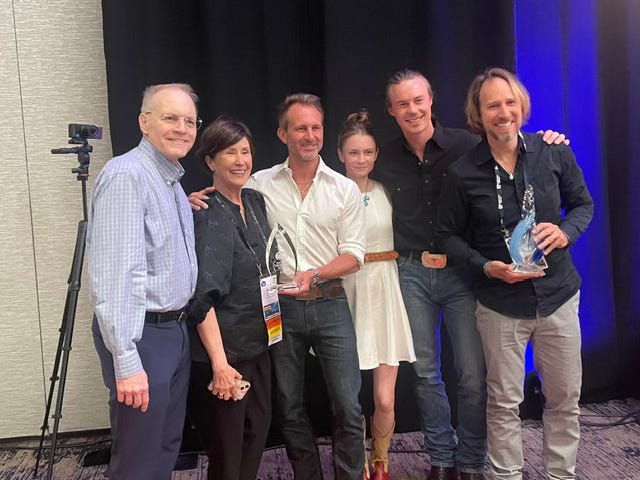
The full list of GSCA Award winners follows:
Best Film, Short Subject:
Jonathan Bird, Tim Geers, Call of the Dolphins (MacGillivray Freeman Films)
Best Film, Feature Length:
James Cameron, Jon Landau, Avatar: Fire and Ash
Best Cinematography:
Jonathan Bird, Tim Geers, Noah Ramirez, Call of the Dolphins
Best Sound Design:
Jonathan Bird, Noah Ramirez, Call of the Dolphins
Best Original Score:
Barnaby Taylor, Horse Power (SK Films)
Best VFX:
Switch VFX, Secrets of Great Salt Lake (SK Films)
Best Film for Lifelong Learning:
Ian Shive, Jonathan Williams, Wild Rescue (Cosmic Picture)
Imax Hall of Fame Award:
Jerusalem, Cosmic Picture
Special Film Recognition:
To Fly!, MacGillivray Freeman
Special Theater Recognitions:
Cincinnati Museum Center and MacGillivray Freeman
Museum of Discovery & Science and MacGillivray Freeman
Best Film Launch by a Theater: (Tie)
Fort Worth Museum for Horse Power
Clark Planetarium for Lost Wolves of Yellowstone
Best Marketing Campaign by a Distributor:
MacGillivray Freeman Films, Call of the Dolphins
Big Idea:
Fort Worth Museum of Science and History for inclusive use of community partnerships
Clark Planetarium for its “Find Your Wild” campaign
Big Shoe (presented for GSCA volunteerism)
Brian Eimer, ImagesInSound