
Sci-Tech Awards Preview: 'The Development Never Stops'
Paul Debevec's HDR image-based lighting techniques and Andrea Weidlich's research supporting photorealistic rendering are among this year's honorees.


By Carolyn Giardina
The Academy of Motion Picture Arts and Sciences will present its annual Scientific and Technical Awards on Tuesday, honoring 15 achievements represented by 27 individual award recipients, that have had significant and lasting impact on motion pictures. For those in the entertainment industry’s SciTech community, it’s one of the year’s highlights.
“One of the things that we really focused on within the last few years is reaching out to all the branches of the Academy and really trying to source [achievements] from different areas,” says Darin Grant, who co-chairs with Rachel Rose (a past recipient herself) the Academy’s Scientific and Technical Awards Committee.
This year’s honored achievements range from lead-free bullet hits, to advancements in stop-motion animation and sound restoration, to software for creating 2D animation styles in 3D animation (such as the looks of Spider-Man: Into The Spider-Verse or The Wild Robot).
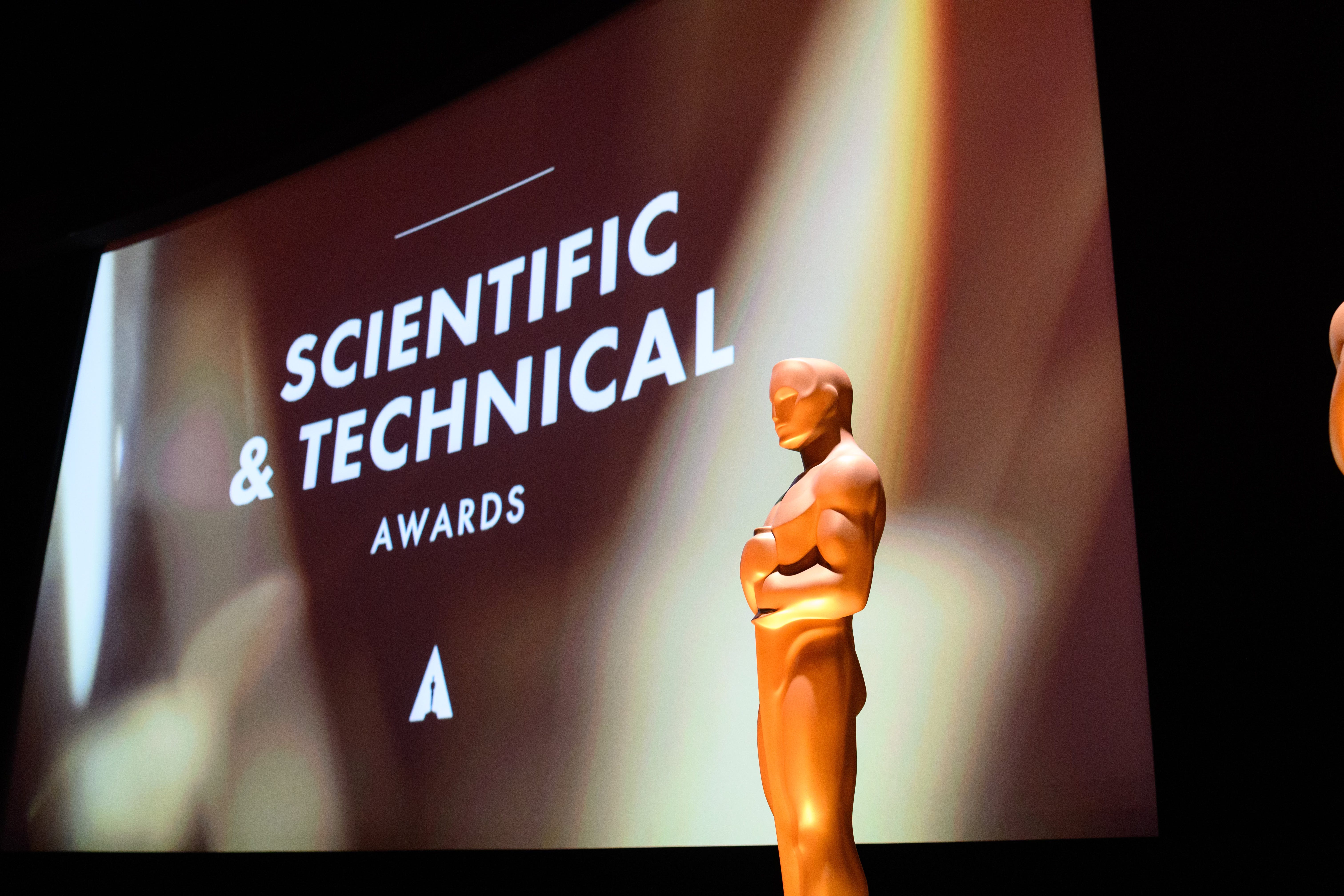
Photo credit: Oscar Aguila / The Academy
Many of the achievements started with an aim to solve a specific problem. For instance, Rose explained that bullet hit squibs have been used in production since the 1940s but in recent decades there were growing concerns that they involved lead-based chemicals. “The only way to preserve that artistic way of viewing bullet hits was to get rid of the lead, so we’re awarding three different individuals who developed, independently, lead free formulations.” They are Brent Bell, Josef Köhler, and Ian Medwell.
Honoree Paul Debevec will be recognized for HDR image-based lighting techniques that have enabled artists to work more productively and improved the realism of CGI characters and environments in feature films. This work began the ‘90s when Debevec was studying at UC Berkeley. “I was fascinated with how VFX companies could add CGI creatures and robots to scenes looking like they were really there with the live-action characters,” he said, noting that “a big part of this effect was matching the lighting on the CGI elements to the lighting in the scene.
“But I found out that the techniques of the day were very manual and prone to error – nothing I thought I could use in my own films,” he continued. “So I invented a process to capture the lighting on a location with panoramic HDR photography, and then to use this image-based lighting in specialized rendering software to light the CGI elements with the light that was really there in the scene – shadows and reflections and all.”
Some of the first movies to use HDR IBL to light key characters were X-Men, The Matrix Reloaded, and The Curious Case of Benjamin Button. Most recently, this included lighting many of the Na’vi in Avatar: Fire and Ash and the CG shots of Rocky in Project Hail Mary.
Andrea Weidlich is another 2026 honoree, for her research on layered materials and implementation of the layering operators and BSDFs (bidirectional scattering distribution function) in Wētā FX’s Manuka renderer, which has been influential in VFX photorealism.
This development has been applied to work on all of Weta FX’s projects since 2014’s Dawn of the Planet of the Apes, including subsequent Planet of the Apes movies, a string of Marvel movies such as Avengers: Endgame, DC movies such as 2025’s Superman, and James Cameron’s second and third Avatar films.
Her two decades of research in this area has impacted the work of countless VFX artists. Weidlich notes that this is about providing them with “the tools to express themselves in the way they want, so that they don’t have to think about technology. Because what they do is not about technology, it’s about the images they make.”
This is still a male-dominated area of the business, and Weidlich hopes that her award could help to encourage more women to study computer science. “I hope it shows women and girls that [gender] is really not an issue, but they can totally do it,” she says.
Rendering has advanced to a point where CG can be photoreal, effectively indistinguishable from live action. But Weidlich notes that there’s always room for further improvement. “There is always the amount of time you need to spend to get something done,” she says as an example. “If you can get, let’s say a simulation quicker, or a rendering quicker, then you can have more turnaround time, and then you have more time for creativity and you have more time to express yourself. So I don’t think the development ever stops. There’s always a next show which has different requirements. Something the audience has never seen before needs more research. This is a reason why it’s important to have researchers like me in VFX.”
Debevec’s work also continues. “I’ve been working more recently on estimating lighting in scenes even when no one shot an HDRI map - which happens a lot too,” he relates. “This can be done by collecting HDRI lighting measurements from real and synthetic scenes, and training a model to predict a plausible HDRI map for the scene just from the background plate.” Debevec is Netflix’s director of research, creative algorithms and technology, and there’s also a relatively new stage at Netflix’s Eyeline Studios called the Light Dome, where filmmakers can reproduce HDRI lighting conditions using 1,500 RGBWA (red-green-blue-white-amber) LED light sources.
The Awards Committee does meticulous research before awarding a SciTech honor, therefore the call for entries for the 2027 SciTech Awards is expected to open in June. Academy membership isn’t required for entrants.
A full list of this year’s honored achievements and individuals can be found here. Check back to The Creative + Tech Orbit for coverage of Tuesday night’s Sci-Tech Awards ceremony, which will be held at the Academy Museum of Motion Pictures in Los Angeles.